Key Takeaway: Fenben Lab is one of the oldest fenbendazole brands on the market, but an independent investigation reveals a hidden network of at least four subsidiary brands, self-issued lab certificates, and conflicting independent purity test results ranging from 7% to 56% — far below the claimed 99.6%. This investigation rates Fenben Lab C — Average Trust due to significant transparency concerns despite their strong market presence.
What Is Fenben Lab?
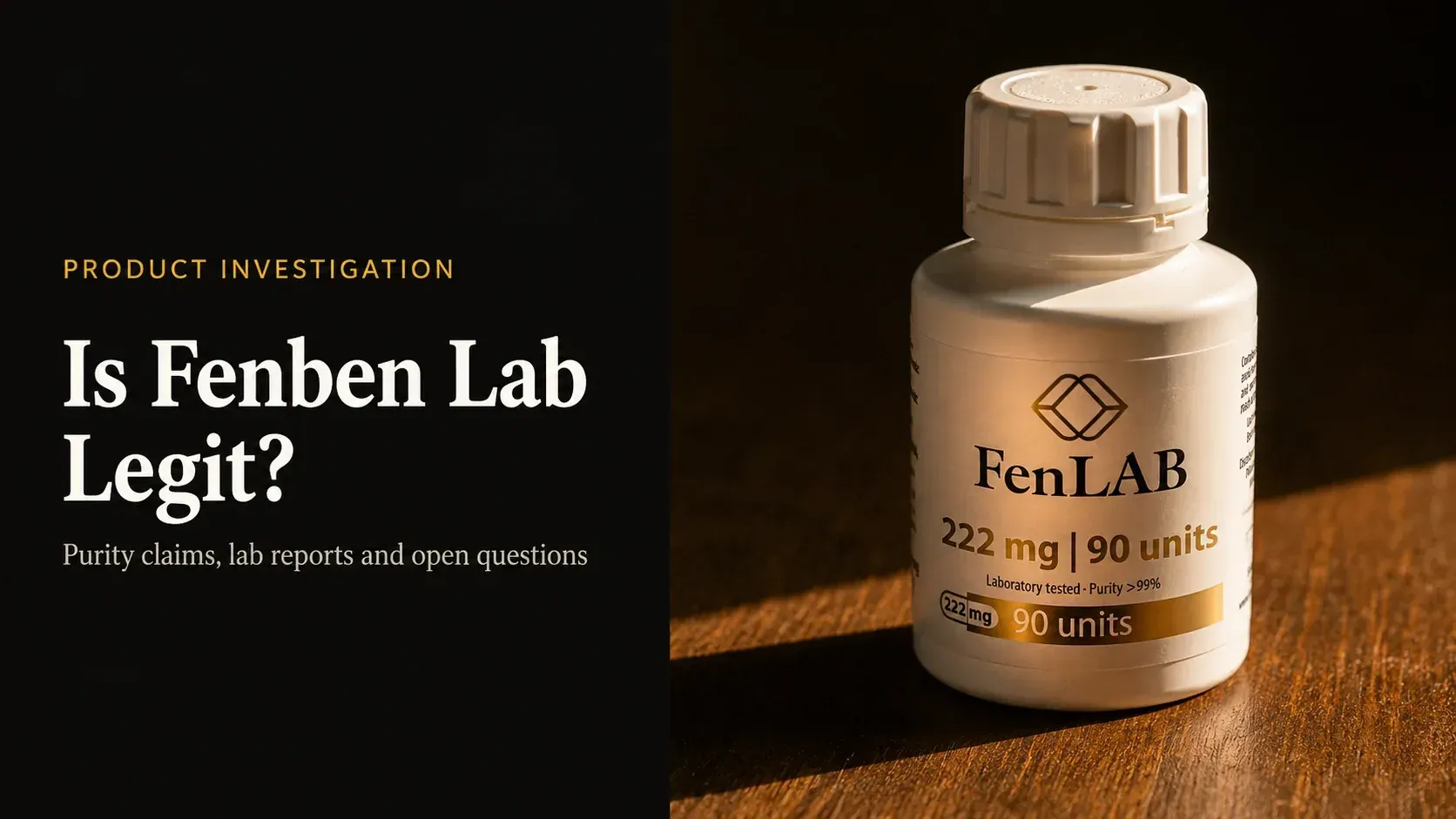
Fenben Lab is a Lithuania-registered company that has positioned itself as one of the leading fenbendazole supplement brands in the market. Operating for more than 20 years, the company sells fenbendazole capsules in 222mg and 444mg dosages as well as powder formulations. They claim a 4.8/5 rating on Trustpilot from over 1,300 reviews, offer phone and email customer support, and advertise U.S.-based warehouses for domestic shipping.
On the surface, Fenben Lab appears to be a well-established, reputable brand. However, our independent investigation — spanning corporate registries, independent lab analyses, product photography comparison, and certificate verification — reveals a more complex picture. This article presents our findings in full, with evidence, so consumers can make an informed decision.
If you are researching fenbendazole brands, we recommend also reading our detailed guides on the Joe Tippens Protocol, our comprehensive overview of fenbendazole case reports and clinical evidence, and our analysis of fenbendazole absorption and bioavailability to understand what makes a quality fenbendazole product.
Fenben Lab: Product Specifications at a Glance
Before diving into the investigation, here is a summary of what Fenben Lab offers and what they claim on their website:
Investigation: What We Found
Our investigation examined four key areas: corporate structure and subsidiary brands, product packaging and certificate authenticity, independent purity testing, and the brand's response to criticism. Each finding is documented with visual evidence below.
1. Hidden Network of Subsidiary Brands
Fenben Lab controls at least four subsidiary brands: Naresun, Fenzol, FenbenPro, and Curer Lab. Three of these are registered in Lithuania, and multiple share the same city — Vilnius. The entity Adisant UAB/LTD appears across certificates for both Naresun and Fenzol.
To an average consumer searching for fenbendazole online, these appear as five separate, competing companies. In reality, they are all part of the same operation. This practice artificially expands their market presence and makes it harder for consumers to compare genuine alternatives.
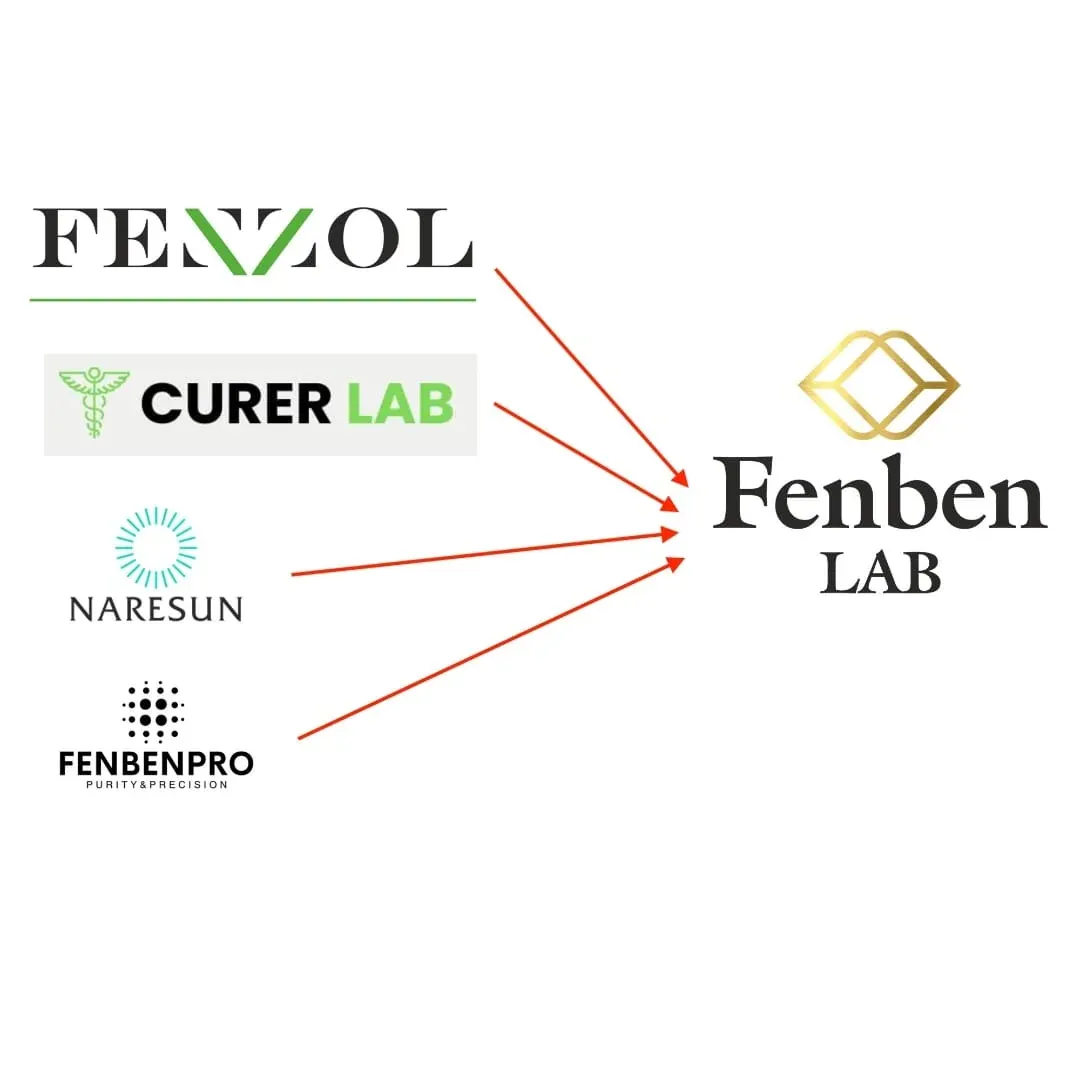
Corporate structure: Fenben Lab and its subsidiary brands all trace back to Lithuanian registrations
Here is a detailed breakdown of the subsidiary network we identified:

Registration details showing overlapping corporate entities across brands
2. Identical Products Across Brands
Our visual comparison of product listings across the subsidiary brands revealed systematic reuse of product photography, packaging designs, and even measuring spoons. FenbenPro and Fenben Lab share an identical spoon design with the same font — a detail manufacturers would never coincidentally replicate. Fenzol and Fenben Lab use the same package, the same box design, and mirrored product photos.
This matters because consumers rely on product images to distinguish between brands. When multiple "competing" brands use identical assets, it is not competition — it is the same company selling the same product under different labels at potentially different price points.
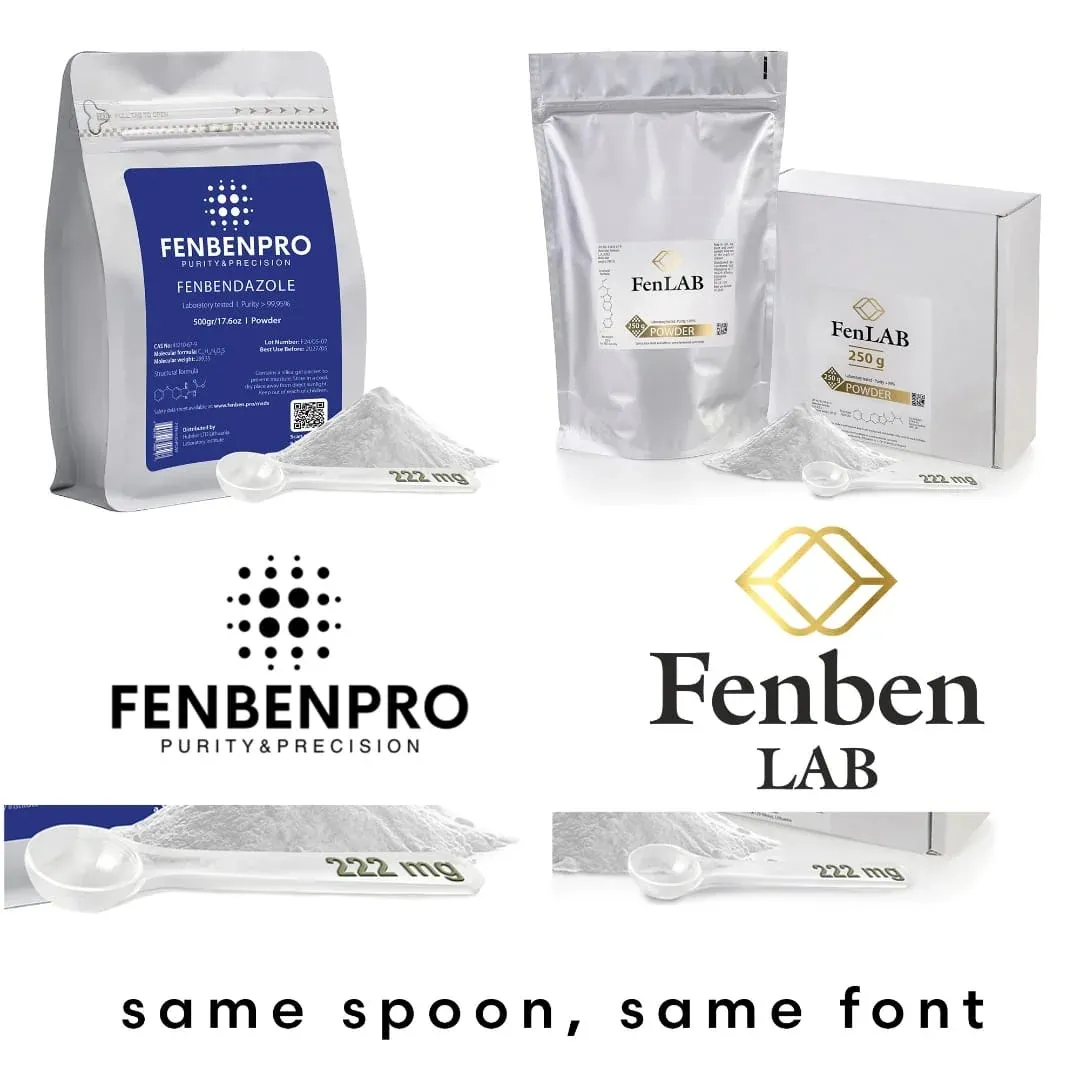
Same spoon, same font — FenbenPro vs. Fenben Lab
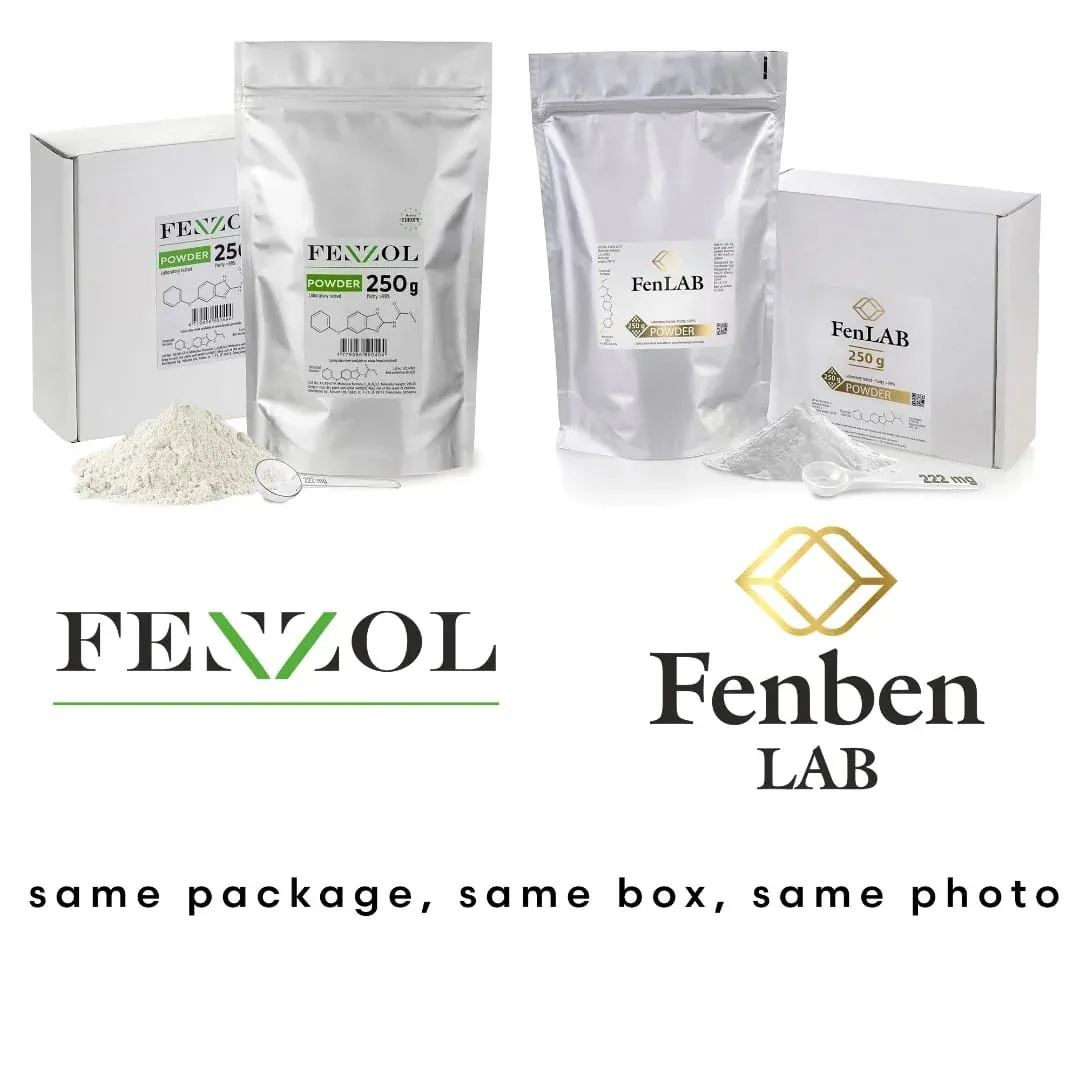
Same package, mirrored images — Fenzol vs. Fenben Lab
3. Self-Issued Certificates with Recycled Data
A critical part of any supplement brand's credibility is the Certificate of Analysis (COA). Genuine COAs are issued by independent, accredited laboratories and contain unique batch numbers, testing dates, and methodology descriptions. What we found with Fenben Lab's certificates raises serious questions.
The certificates provided by Fenben Lab and its subsidiaries share several concerning characteristics:
- No independent laboratory name — the certificates do not identify a recognized third-party testing facility
- Identical data across brands — certificates for Fenben Lab, Naresun, and Fenzol contain the same test values, suggesting they were generated from a single template rather than from separate lab analyses of different product batches
- Email address typos — one certificate contains a typo in the contact email, which persists identically across multiple brand certificates — a telltale sign of copy-paste duplication rather than independent testing
- No batch-specific testing — there is no indication that each production batch undergoes individual analysis, which is standard practice for any supplement manufacturer following FDA cGMP guidelines
A legitimate supplement manufacturer would commission independent testing from an accredited laboratory for each production batch and provide consumers with verifiable, batch-specific COAs. The pattern we observe here — recycled certificates with identical data across supposedly independent brands — is inconsistent with genuine quality assurance practices.
4. The Naresun–Fenben Lab Connection
The relationship between Naresun and Fenben Lab deserves special attention because it illustrates the subsidiary pattern most clearly. Both brands are registered in Vilnius, Lithuania. The entity Adisant UAB (also appearing as Adisant LTD) is listed on official documents for both companies.
When customers purchase from Naresun, they may believe they are choosing an alternative to Fenben Lab. In reality, the corporate registrations, certificate formats, and product specifications are virtually identical. This is not unique to Naresun — Fenzol and Curer Lab follow the same pattern.
For consumers who value genuine brand competition and independent quality verification, this subsidiary structure means that choosing between Fenben Lab, Naresun, Fenzol, FenbenPro, or Curer Lab is not a real choice — it is selecting from the same supplier's catalog.
5. Purity Questions: Independent Testing Reveals Dramatic Discrepancies
Perhaps the most concerning finding in this investigation involves the actual purity of Fenben Lab's fenbendazole product. Fenben Lab claims a purity of 99.6% on their website. However, two independent sources paint a very different picture.
Dr. William Makis MD, a well-known figure in the repurposed drug community and author of a comprehensive repurposed drug protocol, tested Fenben Lab's product and reported a purity of only 56%. Separately, Spectrix Analytical Services — a professional analytical laboratory — found the fenbendazole content to be just 7.05%.
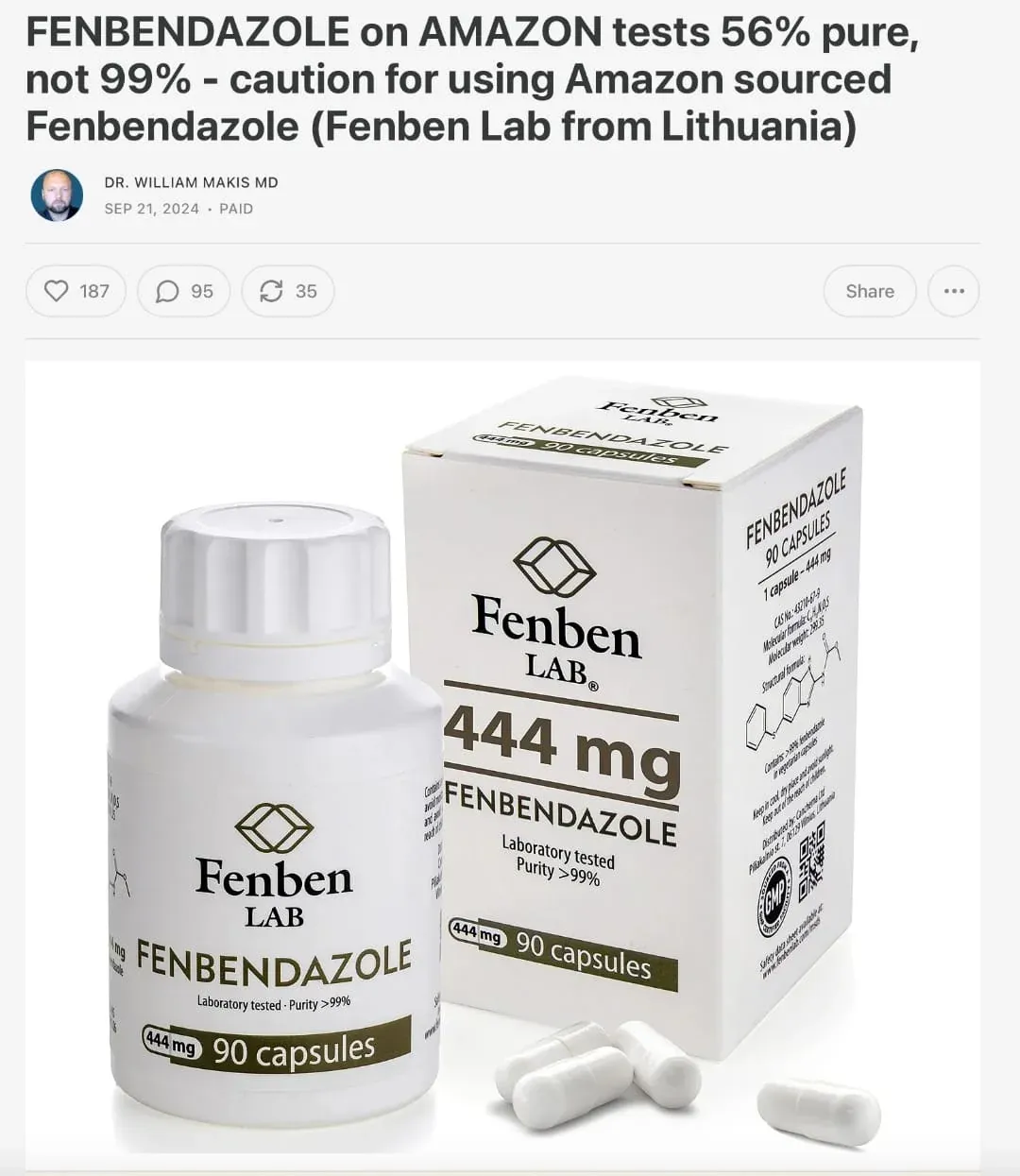
Dr. William Makis test: 56% purity
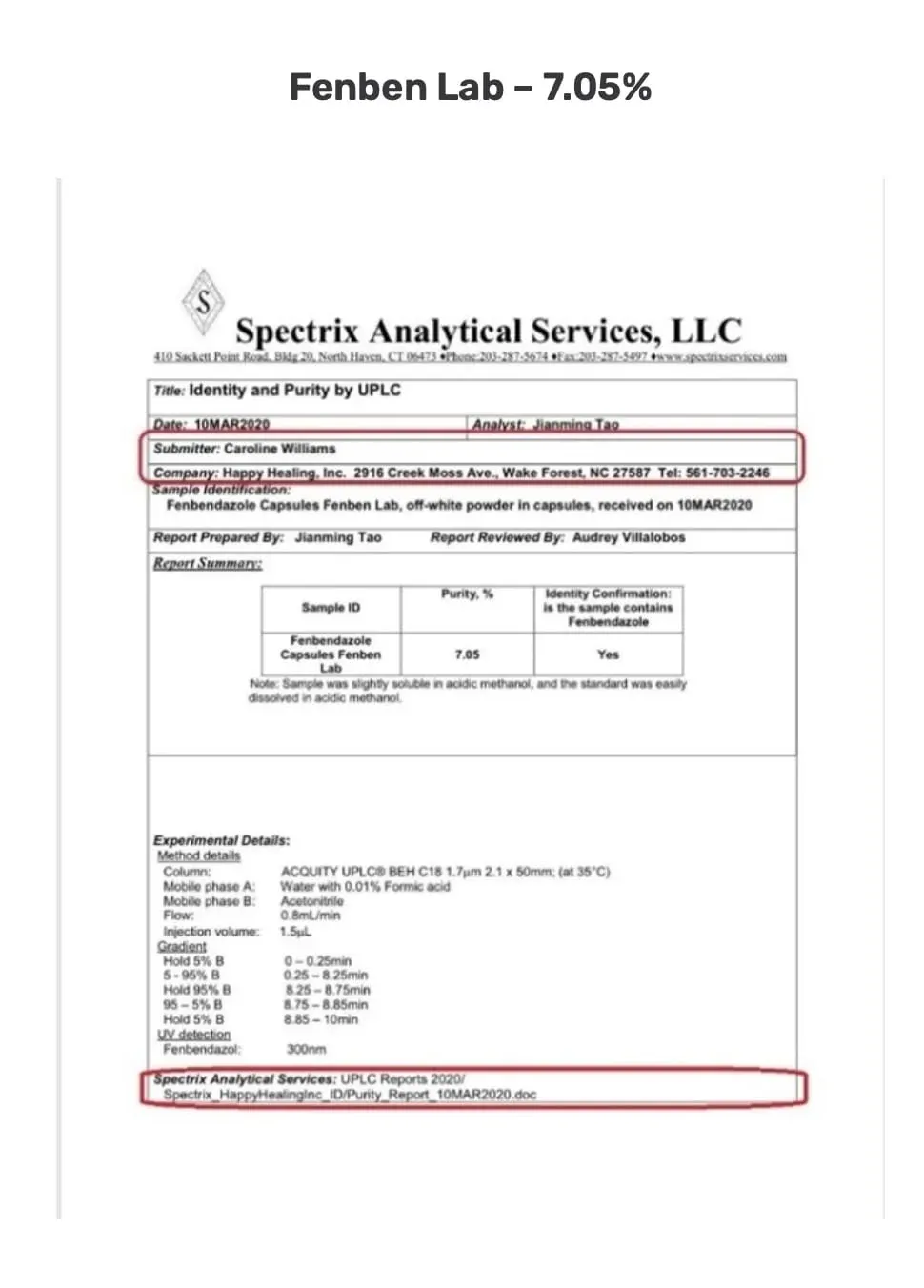
Spectrix Analytical: 7.05% purity
The purity discrepancy is stark when viewed side by side:
The gap between the claimed 99.6% and the independently tested values (7.05%–56%) is extraordinary. Even taking the higher independent result of 56%, consumers would be receiving barely half the active ingredient they expect. At the lower Spectrix result of 7.05%, the product would be almost entirely filler.
It is important to note that different analytical methods can produce different results. However, a discrepancy of this magnitude — where independent tests find between 7% and 56% against a claimed 99.6% — cannot be explained by methodological variation alone. This points to either significant quality control problems or inaccurate labeling.
6. The Sodium Carbonate Question: What Is the Other 44–93%?
If independent testing shows that Fenben Lab's product contains only 7–56% fenbendazole, the obvious question is: what comprises the remaining 44–93% of the capsule content?
Analysis suggests that sodium carbonate (a common industrial chemical also known as soda ash or washing soda) may account for a significant portion of the filler material. Sodium carbonate is inexpensive, readily available, and has a white powder appearance similar to pharmaceutical-grade fenbendazole.
While sodium carbonate is generally recognized as safe in small dietary quantities, it is not an inert pharmaceutical excipient. In significant concentrations, it can:
- Cause gastrointestinal irritation
- Alter the pH of the digestive environment, potentially affecting the absorption of other supplements or medications
- Create a misleading impression of product volume and potency
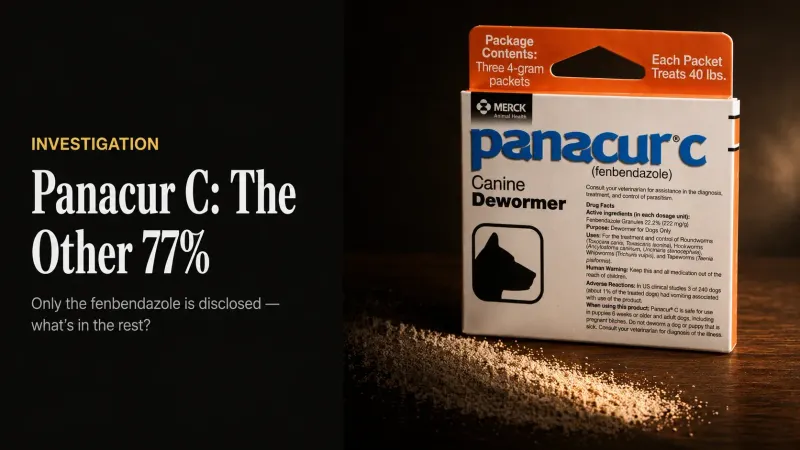
This is fundamentally different from legitimate pharmaceutical excipients (such as microcrystalline cellulose or magnesium stearate) that are specifically chosen for their inert properties and pharmaceutical compatibility. For context, see our investigation into Panacur C's hidden excipients, where we documented how ~77.8% of each sachet consists of undisclosed fillers — a pattern that appears across the fenbendazole market.
7. Fenben Lab's Response: The "Smear Campaign" Defense
When confronted with negative test results and critical reviews, Fenben Lab has publicly characterized these findings as a coordinated "smear campaign" by competitors. This is a common defensive strategy in the supplement industry, and it deserves examination on its own merits.
The "smear campaign" hypothesis would require:
- Multiple independent parties (Dr. Makis, Spectrix Analytical, independent reviewers) to be coordinating against a single brand — without any evidence of such coordination
- Analytical laboratories to produce falsified results that risk their professional accreditation — an extremely unlikely scenario for established labs
- Consistent falsification — the fact that multiple independent tests from different sources all show dramatically low purity suggests a real quality issue, not a conspiracy
The more parsimonious explanation is that the independent tests reflect genuine quality concerns. Fenben Lab could resolve this definitively by commissioning testing from a mutually agreed-upon, accredited laboratory and publishing the full results with methodology. To date, they have not done so.
8. The Trustpilot High-Rating Paradox
One of the most common counter-arguments to concerns about Fenben Lab is their impressive 4.8/5 Trustpilot rating with over 1,300 reviews. How can a brand with questionable purity maintain such high customer satisfaction?
Several factors may explain this paradox:
- Customer expectations vs. laboratory standards: Most fenbendazole consumers cannot assess product purity at home. If a capsule looks, smells, and dissolves like fenbendazole, most customers will report satisfaction — even if the actual fenbendazole content is significantly below the label claim
- The placebo component: For consumers taking fenbendazole alongside other protocols (vitamins, dietary changes, conventional treatment), attributing outcomes to any single supplement is extremely difficult
- Service quality ≠ product quality: Trustpilot reviews often evaluate shipping speed, customer service responsiveness, and packaging — not product purity. Fenben Lab does appear to provide good logistical service
- Review solicitation timing: Many supplement brands request reviews shortly after delivery, before customers have had time to evaluate product effectiveness
A high Trustpilot rating is certainly a positive signal for customer service quality. But it should not be confused with independent verification of product purity — these are fundamentally different measures.
How Does Fenben Lab Compare to Other Fenbendazole Brands?
To put Fenben Lab's transparency and quality indicators in context, here is a comparison with other fenbendazole brands we have independently investigated:
The key differentiator is independent, third-party laboratory verification. Brands that provide verifiable COAs from accredited laboratories give consumers genuine assurance about product quality. Self-issued certificates, regardless of how professional they appear, do not meet this standard.
How to Verify Fenbendazole Quality Before You Buy
Whether you are evaluating Fenben Lab or any other fenbendazole brand, here are practical steps to assess product quality and brand transparency:
- Request the Certificate of Analysis (COA): Ask the brand for a batch-specific COA. Check that it names a recognizable, accredited third-party laboratory — not just the brand itself
- Verify the laboratory: Search for the testing laboratory online. Accredited labs will have ISO 17025 certification or equivalent. Contact them directly to confirm they tested the product
- Check for batch numbers: Every legitimate COA should include a unique batch/lot number that corresponds to the product you purchased
- Look for UPLC-PDA or HPLC methodology: These are gold-standard analytical methods for quantifying fenbendazole content. If a COA does not specify the testing method, it may not be from a real laboratory analysis
- Research the corporate structure: Search business registries for the brand's parent company. Multiple brands registered to the same entity or address is a transparency red flag
- Cross-reference reviews: Look beyond Trustpilot — check independent forums, Reddit communities, and consumer protection databases for unfiltered feedback
- Compare purity claims across sources: If a brand claims 99%+ purity but independent analyses show significantly different numbers, exercise caution
For a deeper understanding of what affects fenbendazole product quality, read our article on maximizing fenbendazole absorption and the science behind fenbendazole and vitamin E synergy.
Conclusion: Rating C — Average Trust
Fenben Lab has built genuine market presence that cannot be dismissed: 20+ years of operation, a 4.8/5 Trustpilot rating from over 1,300 reviews, phone support, U.S. warehouses, and a professional-looking website. On logistical and customer service metrics alone, Fenben Lab would likely earn a B rating.
However, our investigation uncovered a combination of factors that significantly undermines trust:
- A hidden network of at least four subsidiary brands (Naresun, Fenzol, FenbenPro, Curer Lab) all registered in Vilnius, Lithuania — presented to consumers as independent competitors
- Self-issued certificates recycled across subsidiary brands, with identical data and copied email typos — not genuine independent lab testing
- Two independent purity tests showing dramatically lower fenbendazole content (56% and 7.05%) than the claimed 99.6%
- Evidence of sodium carbonate filler potentially making up a significant portion of the product
- A pattern of dismissing criticism as "smear campaigns" rather than commissioning transparent, verifiable third-party testing
Any single one of these findings might be explainable. Together, they form a pattern that is inconsistent with the transparency consumers deserve — especially for a YMYL (Your Money or Your Life) supplement product.
Our rating: C — Average Trust. The operation may deliver a functional product to many customers, but the corporate structure, certificate practices, and purity discrepancies are fundamentally questionable. Consumers should demand independent, verifiable lab testing before purchasing.
For consumers seeking fenbendazole brands with fully verified third-party testing, see our complete fenbendazole evidence review and individual brand reviews across our site.
Frequently Asked Questions
Is Fenben Lab a legitimate company?
Fenben Lab is a registered company in Lithuania with over 20 years of market presence. It is a real business entity. However, our investigation raises concerns about their transparency regarding product testing, certificate authenticity, and the hidden subsidiary brand network.
What is the actual purity of Fenben Lab fenbendazole?
Fenben Lab claims 99.6% purity. However, two independent analyses report significantly lower figures: Dr. William Makis found 56% purity, and Spectrix Analytical Services found 7.05% via UPLC-PDA analysis. The actual purity remains uncertain due to the absence of verifiable third-party testing from Fenben Lab.
Are Fenben Lab and Naresun the same company?
Our investigation found strong evidence connecting the two. Both are registered in Vilnius, Lithuania, and the entity Adisant UAB/LTD appears on official documents for both brands. Along with Fenzol, FenbenPro, and Curer Lab, they appear to operate as part of the same corporate structure.
Does Fenben Lab provide independent lab certificates?
Fenben Lab provides certificates, but our analysis indicates they are self-issued rather than from an independent, accredited third-party laboratory. The same certificate data — including a typographical error in the email address — appears across certificates for multiple subsidiary brands.
Why does Fenben Lab have such high Trustpilot reviews?
Fenben Lab's 4.8/5 Trustpilot rating likely reflects good customer service, fast shipping, and professional packaging — not product purity verification. Most consumers cannot test fenbendazole content at home, and reviews are typically submitted shortly after delivery, before product quality can be meaningfully assessed.
Where is Fenben Lab manufactured?
The exact manufacturing location is not transparently disclosed. The company is registered in Vilnius, Lithuania, and claims to have U.S. warehouses for domestic shipping, but the production facility details remain unclear.
What is sodium carbonate and why is it a concern?
Sodium carbonate (soda ash) is an inexpensive industrial chemical. If it comprises a significant portion of a fenbendazole capsule as filler, it reduces the active ingredient per dose and may cause gastrointestinal irritation. Legitimate pharmaceutical excipients are specifically chosen for their inert and safe properties.
How can I verify if my fenbendazole product is genuine?
Request a batch-specific Certificate of Analysis (COA) that names an accredited third-party lab. Verify the lab independently. Look for UPLC-PDA or HPLC testing methodology. Cross-reference the brand's claims with independent reviews and lab analyses.
Is Fenben Lab fenbendazole safe to take?
Fenbendazole as a compound has a generally favorable safety profile based on published research. However, if a product contains significantly less fenbendazole than claimed — and more filler material of uncertain composition — the safety profile changes. We recommend using brands that provide verifiable third-party purity testing. Always consult a healthcare professional.
What fenbendazole brands are better alternatives to Fenben Lab?
We recommend brands that provide independent, third-party laboratory testing with verifiable COAs. Key factors to look for include: accredited lab COAs, transparent corporate structure, batch-specific testing, and disclosed manufacturing locations. See our individual brand reviews for detailed analyses.
Free · No spam · Unsubscribe anytime
Get the research before the sellers spin it
Join readers getting evidence-based fenbendazole protocols, dosing guides, and honest product investigations — straight to your inbox. We read the studies so you don’t get sold a story.
Subscribe free →📚 References & Sources
- Fenbendazole acts as a moderate microtubule destabilizing agent — Scientific Reports (2018)
- Repurposing of benzimidazole anthelmintics as anticancer agents — Future Medicinal Chemistry (2021)
- Fenbendazole as a potential anticancer drug — case report — Anticancer Research (2022)
- Benzimidazoles in cancer therapy: current perspectives — Cancer Letters (2023)
- Drug-induced liver injury from fenbendazole — Cureus (2019)
- FDA — Current Good Manufacturing Practice (cGMP) for Dietary Supplements
- USP — Dietary Supplement Verification Program
- FDA — Dietary Supplement Labeling Guide
- Quality and consistency of dietary supplements — Journal of Clinical Pharmacy (2017)
- Improving bioavailability of poorly water-soluble drugs — BPS Bulletin of Pharmaceutical Sciences (2019)
⚖️ Conflict of Interest Disclosure
This article is an independent, evidence-based review. We have no financial relationship, sponsorship, or affiliate agreement with any product manufacturer mentioned. Our assessments are based on publicly available data including laboratory analyses, manufacturing certifications, and published research. We receive no compensation for favorable or unfavorable reviews.
Disclaimer: This article is for informational purposes only and does not constitute medical advice. Fenbendazole is not FDA-approved for human use. Always consult a qualified healthcare professional before starting any supplement regimen. Product ratings reflect publicly available data, lab testing availability, manufacturer transparency, and community feedback.
🔬 How we research & review this article
This article is an independent, evidence-based review. Every clinical claim is sourced from primary literature (PubMed, ClinicalTrials.gov, FDA/WHO). Sources are selected for methodological quality, uncertainties are stated plainly, and conflicts of interest are disclosed. Content is reviewed and updated on a rolling schedule — see the “Last reviewed” date at the top (July 2026).