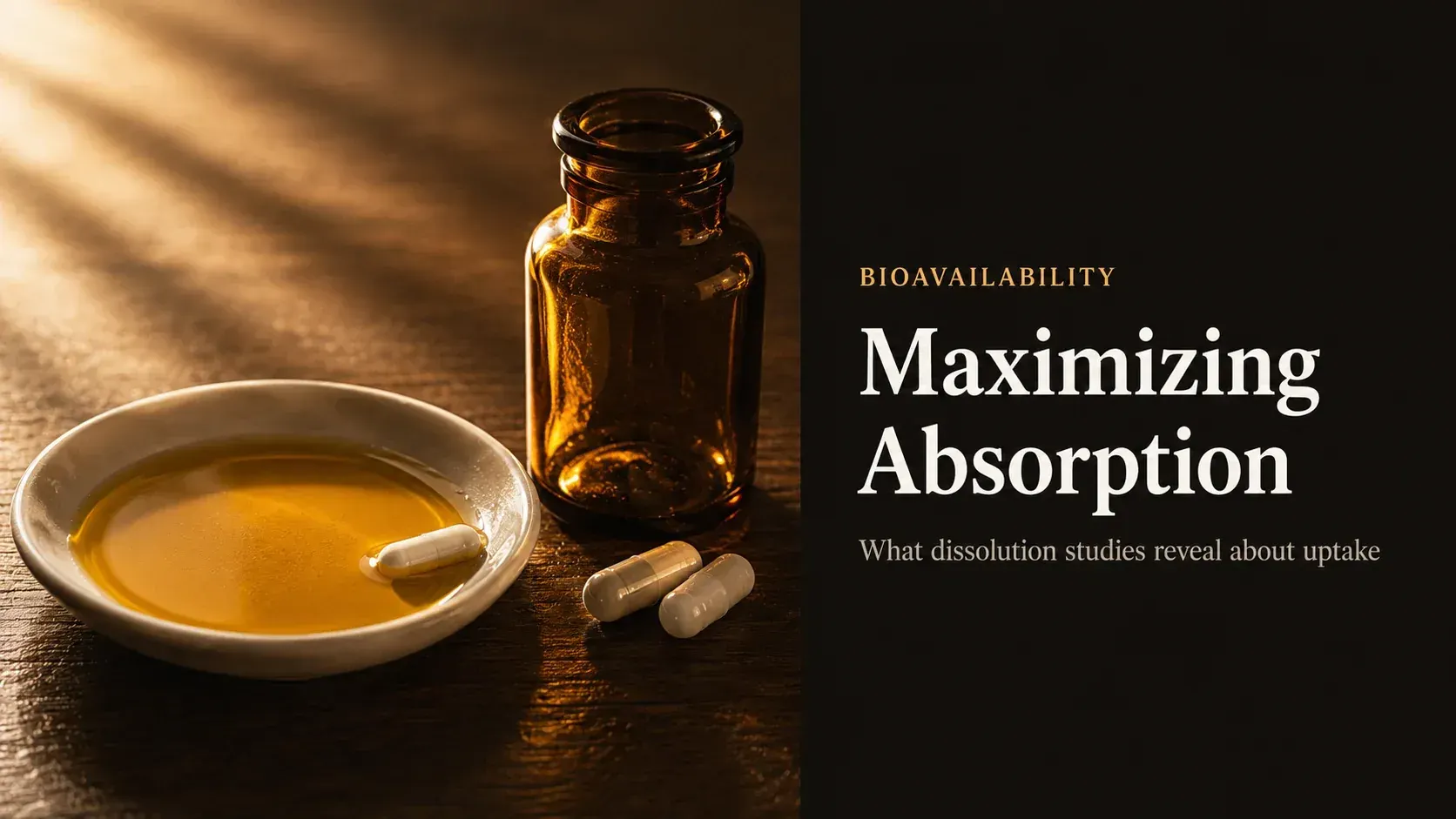
Fenbendazole absorption is the quiet variable that decides whether an oral dose does anything at all. Two people can swallow the exact same number of milligrams and end up with wildly different amounts of drug in their bloodstream — because the milligrams on the label are not the milligrams that reach circulation.
The reason is chemistry. Fenbendazole is a benzimidazole with excellent ability to cross cell membranes but a stubborn refusal to dissolve in water. In the language of pharmaceutics, it is a compound whose fate is decided in the first few hours inside the gut — long before it ever reaches a tumor cell, a parasite, or a liver enzyme. This article takes the absorption question apart step by step: the molecule's physical properties, what happens to it at each stage of digestion, why dietary fat matters so much, how the liver transforms it, and what all of this means for anyone trying to understand the compound honestly.
Why Absorption Is the Whole Ballgame
Every discussion of fenbendazole eventually returns to one uncomfortable fact: most of an oral dose is never absorbed. It passes through the digestive tract and leaves the body largely unchanged. This is not a defect unique to fenbendazole — it is a shared trait of the entire benzimidazole family, which veterinary pharmacologists have studied for decades precisely because poor absorption limits how well these drugs work against parasites living outside the gut.
Understanding absorption matters for three practical reasons. First, it explains the enormous gap between the dose someone takes and the systemic exposure they actually achieve. Second, it clarifies why small changes — taking a capsule with a fatty meal instead of on an empty stomach — can shift blood levels more than doubling the dose would. Third, it reframes the entire conversation away from "how much should I take" toward "how much am I actually absorbing," which is the more scientifically meaningful question.
Absorption is also where most of the accessible, evidence-based levers live. You cannot easily change fenbendazole's molecular structure at home, but you can change the environment it lands in. That environment — the timing of food, the presence of fat, the state of the gut — is what this article is really about.
The Molecule Itself: Fenbendazole's Physicochemical Profile
To understand why fenbendazole behaves the way it does, you have to start with the molecule. Fenbendazole (CAS 43210-67-9) is chemically defined as methyl (6-(phenylthio)-1H-benzo[d]imidazol-2-yl)carbamate. It is a white to light-yellow crystalline powder, odorless and essentially tasteless, with a molecular weight of 299.35 g/mol and a melting point around 233°C (with decomposition).
Two properties dominate its behavior in the body. The first is its near-total insolubility in water. Fenbendazole is described in reference sources as practically insoluble in aqueous media; it dissolves far more readily in organic solvents such as dimethyl sulfoxide (around 16.67 mg/mL) and dimethylformamide (around 10 mg/mL), and it partitions preferentially into octanol rather than water — the signature of a lipophilic, "fat-loving" molecule. The second key property is that its solubility is pH-dependent: it dissolves somewhat better in more acidic conditions, a detail that turns out to matter as the drug moves between the stomach and the intestine.
| Property | Value | Why It Matters for Absorption |
|---|---|---|
| Molecular weight | 299.35 g/mol | Small enough to cross membranes easily once dissolved |
| Water solubility | Practically insoluble | The core bottleneck — undissolved drug cannot be absorbed |
| Lipophilicity | High (prefers octanol over water) | Dissolves into fats and bile-salt micelles, not water |
| pKa | ~10.8 (predicted) | Stays largely un-ionized across the gut pH range |
| Solubility vs pH | Higher at lower pH | Stomach acidity can aid initial dissolution |
| Melting point | ~233°C (dec.) | Stable crystalline solid; slow to dissolve |
Put simply: fenbendazole is a lipophilic solid that would much rather sit as an undissolved crystal or dissolve into fat than mix into the watery contents of the gut. Every absorption strategy that follows is, in one way or another, an attempt to work around that single fact.
BCS Class II: Why Dissolution, Not Permeability, Is the Bottleneck
Pharmaceutical scientists classify oral drugs using the Biopharmaceutics Classification System (BCS), which sorts compounds by two variables: how well they dissolve and how well they cross the intestinal wall. Fenbendazole is a textbook BCS Class II drug — low solubility, high permeability.
This classification is more than academic labeling; it tells you exactly where the traffic jam is. High permeability means that once fenbendazole is dissolved in the intestinal fluid, it passes through the gut lining efficiently. Low solubility means the hard part is getting it dissolved in the first place. In BCS terms, fenbendazole's absorption is dissolution-rate limited: the rate at which the crystalline drug turns into dissolved molecules sets the ceiling on how much can be absorbed.
This has a powerful practical implication. For a Class II drug, anything that speeds or increases dissolution tends to increase absorption almost directly, while the intestinal wall is never the limiting step. That is why formulation science obsesses over dissolution, why dietary fat helps, and why particle-size engineering can nearly double bioavailability. It also explains why simply raising the dose does not scale cleanly — you can only dissolve so much drug in a given volume of gut fluid before the rest passes through untouched.
The Journey Through the Gut: A Stage-by-Stage Map
To see where absorption succeeds or fails, it helps to follow a dose through the digestive tract in order.
The Stomach: First Contact With Acid
After swallowing, fenbendazole reaches the stomach, where the pH is strongly acidic (roughly 1.2–3 in the fasted state). Because fenbendazole's solubility improves at lower pH, the stomach is actually a relatively favorable environment for the first stage of dissolution. In ruminant animals, veterinary pharmacologists have long noted that the acidic compartment of the stomach is important for dissolving benzimidazoles before they move on. The catch is that gastric residence is usually short, especially on an empty stomach, so the drug may not linger long enough to dissolve meaningfully before being swept forward.
The Small Intestine: Where Absorption Happens
The duodenum and jejunum are where the real action occurs. Here the pH rises toward neutral (around 6–7), bile and pancreatic secretions pour in, and the vast surface area of the intestinal lining offers the main site of absorption. This creates a paradox for fenbendazole: the intestine is where it must be absorbed, yet the higher pH there works against its raw solubility. What rescues absorption in the intestine is not water at all — it is the arrival of bile-salt micelles and, if present, digested dietary fat, which can carry lipophilic molecules that plain intestinal fluid cannot.
Transit Time: The Hidden Clock
Because dissolution is slow, the amount of time the drug spends in the absorptive window matters enormously. Anything that slows transit — a substantial meal, dietary fat delaying gastric emptying — gives more dissolved drug the chance to be picked up. Anything that speeds transit shortens the window and can reduce the fraction absorbed. This "residence time" effect is one of the main reasons food changes fenbendazole absorption so dramatically.
Dissolution Science: What the Lab Data Actually Shows
Laboratory dissolution testing puts numbers to the intuition above. In studies simulating gastrointestinal conditions — testing pH from 1.2 (stomach) up to 6.8 (intestinal) at body temperature (37°C) — fenbendazole shows characteristically slow release. Reported results indicate that less than 50% of the compound dissolves within 60 minutes, and that dissolution behavior is pH-dependent, with release improving as conditions approach the intestinal pH of 6.8.
Two lessons come out of this data. First, the slow dissolution confirms exactly what BCS Class II predicts: a large fraction of a standard dose simply never gets into solution during its transit through the gut, and undissolved drug is unabsorbable drug. Second, the pH sensitivity shows why the interplay between the stomach and intestine matters — the compound experiences a changing chemical environment, and its dissolution is a moving target rather than a fixed number.
Formulation scientists use exactly these dissolution curves as the yardstick for improvement. When they report that a solid dispersion reaches 85% dissolution versus roughly 20% for raw powder, or that a nanocrystal cuts the absorption lag time by more than 80%, they are describing shifts in these same curves — moving the compound out of the "less than half dissolved in an hour" regime and into something far more absorbable.
Bile Salts and Mixed Micelles: The Body's Own Solubilizer
One of the most under-appreciated players in fenbendazole absorption is the body's own detergent system: bile salts. Secreted by the liver and released from the gallbladder in response to food, bile salts assemble into microscopic aggregates called micelles. These micelles have a water-friendly outer surface and a fat-friendly interior — precisely the structure needed to ferry a lipophilic molecule like fenbendazole through the watery intestinal fluid to the absorbing surface.
Research on drug–micelle interactions has shown that lipophilic compounds partition into bile-salt micelles in a way that can be quantified, and that the extent of this micellar solubilization correlates with a molecule's octanol–water partition coefficient. In plain terms: the more "fat-loving" a drug is, the more readily bile-salt micelles pick it up, and this micellar loading helps predict how well the drug is absorbed. Because fenbendazole is strongly lipophilic, it is an excellent candidate for micellar solubilization — which is exactly why the presence of bile (triggered by food, and especially by fat) transforms its absorption.
This is the mechanistic bridge between "take it with food" folk advice and actual pharmacology. Food, and particularly fat, triggers a surge of bile into the intestine. That bile forms micelles. Those micelles dissolve fenbendazole that plain water never could. The dissolved, micelle-bound drug is then delivered to the intestinal wall, where its high permeability finally gets to work.
How Dietary Fat Rewrites the Absorption Equation
Dietary fat helps fenbendazole absorption through several overlapping mechanisms, not just one. Understanding them separately clarifies why fat is the single most accessible absorption lever.
Fat Triggers the Lipid Digestion Cascade
When fat enters the small intestine, it sets off a coordinated response: the gallbladder releases bile, the pancreas secretes lipase, and the fat is emulsified and broken down into fatty acids and monoglycerides. These digestion products combine with bile salts to form mixed micelles that are even more capable of solubilizing lipophilic compounds than bile-salt micelles alone. Fenbendazole, riding along in these mixed micelles, effectively hitchhikes on the body's fat-absorption machinery.
Oleic Acid: The Standout Fatty Acid
Not all fats are equal. Monounsaturated fats rich in oleic acid — olive oil being the most accessible example — appear especially effective. In a frequently cited study by Liu et al. (2012) on mebendazole, a close structural relative of fenbendazole, pairing the drug with oleic acid raised serum concentrations substantially, with bioavailability increasing by roughly 1.6 to 2.8 times, and olive oil producing the strongest effect among the oils tested. Because fenbendazole and mebendazole share the benzimidazole scaffold and the same solubility-limited absorption problem, researchers reasonably expect a comparable direction of effect.
Fat Slows Gastric Emptying
Fat also delays how quickly the stomach empties. That delay is beneficial here: it lengthens the time the drug spends dissolving before it is swept through the absorptive small intestine, widening the window during which dissolved drug can be picked up. Slower emptying plus richer micelle formation is a powerful combination for a slow-dissolving Class II compound.
| Fat-Related Mechanism | What It Does | Net Effect on Absorption |
|---|---|---|
| Bile secretion | Fat triggers release of bile salts | Forms micelles that dissolve lipophilic drug |
| Mixed micelle formation | Fatty acids + bile salts combine | Even greater solubilizing capacity |
| Oleic acid enrichment | Monounsaturated fat, e.g. olive oil | Strongest measured enhancement in related drugs |
| Delayed gastric emptying | Fat slows stomach transit | Longer dissolution window |
The Food Effect Beyond Fat
Fat gets most of the attention, but the presence of food itself — even setting aside fat content — independently improves absorption. In canine pharmacokinetic work, administering fenbendazole with food, regardless of the specific fat content, increased total bioavailability compared with dosing on an empty stomach. The most likely explanation is again residence time: a meal slows gastric emptying and prolongs the dissolution window, so more of the slow-dissolving drug gets into solution before it moves past the absorptive region of the gut.
Interestingly, the food effect is not universal across all species. In ruminant animals, some studies show that fasting can actually increase systemic availability of benzimidazoles, because a slower, more prolonged passage through the specialized ruminant stomach changes the kinetics. This species difference is a useful reminder that data from grazing animals cannot be transplanted directly onto human or monogastric physiology — the digestive architecture is fundamentally different.
For monogastric physiology, the consistent, evidence-aligned takeaway is simple: taking fenbendazole with a meal, ideally one containing fat, is the most accessible way to improve its absorption without any special pharmaceutical formulation.
First-Pass Metabolism: Meet Oxfendazole
Getting fenbendazole absorbed across the gut wall is only half the story. Once absorbed, the drug travels via the portal vein straight to the liver, where it faces intense first-pass metabolism before it ever reaches the general circulation. This step shapes not just how much drug survives, but which molecules actually circulate.
In the liver, fenbendazole is oxidized primarily by flavin-containing monooxygenase (FMO) and a set of cytochrome P450 enzymes — including CYP1A1, CYP1A2, CYP3A4, CYP2J2, and CYP2C19 — into its main metabolite, oxfendazole (fenbendazole sulfoxide). Oxfendazole is itself pharmacologically active, so first-pass metabolism does not simply destroy the drug; it converts it into a related active form that becomes the principal circulating species. Oxfendazole can then be further oxidized into fenbendazole sulfone, which is generally regarded as inactive.
| Form | How It Arises | Activity |
|---|---|---|
| Fenbendazole (parent) | The administered compound | Active; poorly soluble, extensively metabolized on first pass |
| Oxfendazole (sulfoxide) | Oxidation by FMO + CYP450 enzymes | Active; the main circulating metabolite after oral dosing |
| Fenbendazole sulfone | Further oxidation of oxfendazole | Generally considered inactive |
There is an elegant wrinkle to this system. In the gut, resident bacteria can reduce oxfendazole back into the parent fenbendazole (and related thioethers). This means the parent and sulfoxide forms can interconvert depending on where they are in the body, and the gut flora effectively participate in the drug's pharmacology. It is one reason the pharmacokinetics of this drug class are more dynamic than a simple one-way metabolism diagram would suggest.
Crucially, first-pass metabolism is saturable. The liver has a finite capacity to process the drug at any given moment. This is a major reason fenbendazole's pharmacokinetics are non-linear — behavior that connects directly to the next section.
Enterohepatic Recirculation and the Role of Gut Bacteria
Fenbendazole and its metabolites are not necessarily "one and done" after the first pass. A portion of the metabolized drug can be secreted into bile and delivered back into the intestine, where some of it may be reabsorbed — a loop known as enterohepatic recirculation. This recycling can extend how long the compound and its active metabolites persist in the body, contributing to the surprisingly long elimination half-lives seen in some species.
The gut microbiome adds another layer. As noted above, intestinal bacteria can chemically reduce metabolites back toward the active parent form. The health, composition, and activity of a person's gut flora are therefore not neutral bystanders — they are part of the machinery that determines how much active drug is present and for how long. This is an area where individual variation is large and poorly characterized, and it is one honest reason why absorption and exposure differ so much from person to person.
Why Absorption Is Not Dose-Proportional
A common and costly misconception is that doubling the dose doubles the amount of drug in the blood. For fenbendazole, that assumption breaks down. Pharmacokinetic studies — for example in dogs — have found that increasing the oral dose does not produce a proportional increase in absorbed drug, indicating a saturation point in the absorption process.
Two saturable bottlenecks explain this. First, dissolution is capacity-limited: there is only so much fluid and so much bile-salt/micelle solubilizing power in the gut at any moment, so beyond a certain point, extra crystalline drug simply cannot dissolve fast enough and passes through unabsorbed. Second, first-pass metabolism is saturable: the liver can only oxidize so much drug at once. Together these produce a ceiling effect, where pushing the dose higher yields diminishing returns in actual systemic exposure while still loading the liver with more drug to process.
This non-linearity is why the scientifically grounded conversation focuses on improving absorption efficiency rather than simply escalating the dose. Better dissolution — through food, fat, or formulation — moves more of each existing milligram into circulation, whereas brute-force dose increases run into the saturation wall and add metabolic burden.
What Animal Pharmacokinetics Teach Us
Because controlled human pharmacokinetic data on fenbendazole is sparse, most quantitative absorption figures come from veterinary studies.[7] These numbers should be read as directional insight into the drug's behavior rather than direct human values, but the patterns are instructive.
| Species | Oral Bioavailability | Time to Peak (Tmax) | Key Insight |
|---|---|---|---|
| Pigs | ~27.1% | ~3.75 hours | Extensive first-pass metabolism; oxfendazole is the main circulating form |
| Dogs | Low; not dose-proportional | Variable | Absorption saturates — higher doses do not scale linearly |
| Llamas | Low (slow absorption) | ~28.4 hours | Much slower than monogastric animals; half-life 16–36 hours |
| Sheep (nanocrystals) | ~1.92× standard | 0.54 h vs 3.3 h | Particle engineering cut absorption lag time by 80%+ |
Several themes recur across species. Oral bioavailability is consistently low. First-pass metabolism to oxfendazole is consistently heavy. Absorption is slow and, where tested, not dose-proportional. And formulation changes — such as nanocrystals in sheep — can move the numbers substantially. The species-to-species spread also underscores how much gastrointestinal architecture matters: the multi-chambered ruminant gut of a llama produces a completely different absorption profile than the simple stomach of a pig or dog.
Formulation Levers: Engineering Around Poor Solubility
Because fenbendazole's problem is dissolution, pharmaceutical scientists have developed several strategies to force more of the drug into solution. These are largely research-stage or veterinary approaches, but they illuminate the underlying science and show what is theoretically possible.
| Approach | How It Works | Reported Result |
|---|---|---|
| Solid dispersions | Drug dispersed in a water-soluble polymer (e.g. Soluplus) | Up to ~85% dissolution vs ~20% for raw powder — roughly 4× |
| Nanocrystals | Particle size reduced to the nanometer range | Bioavailability nearly doubled; absorption lag cut 80%+ |
| Chitosan microspheres | Encapsulation in a biocompatible polymer | Controlled GI release; less unabsorbed drug |
| Lipid-based formulations | Drug pre-dissolved in oils or lipid carriers | Mimics the dietary-fat effect in a standardized format |
The unifying principle is the same one that makes dietary fat work: get the drug into a dissolved or finely divided state so that its high membrane permeability can finally be exploited. Nanoparticle and nanocarrier delivery is a deep field in its own right — from particle geometry to tumor-targeting strategies — and we cover that science separately in our dedicated article on nanoparticle delivery of fenbendazole. For the purposes of everyday absorption, the key point is that these engineered formulations are simply more sophisticated ways of solving the same dissolution problem that a fatty meal partially solves for free.
The Prodrug Strategy: A Different Route to Solubility
The benzimidazole class has also inspired a clever chemical workaround: prodrugs. Compounds such as febantel, netobimin, and thiophanate are administered in a more soluble or differently structured form, then metabolically converted inside the body into active benzimidazole carbamates. This sidesteps some of the dissolution bottleneck at the point of administration by delivering a molecule that behaves better in the gut and only becomes the poorly soluble active drug after it has been absorbed and transformed.
Fenbendazole itself is sometimes considered in this context because of its interconversion with oxfendazole — administering one can effectively supply the other through metabolism. The prodrug concept reinforces the central theme of this article: much of anthelmintic pharmacology is a decades-long effort to outmaneuver the poor water solubility that defines the entire drug class.
Turning the Science Into a Practical Routine
Translating all of this pharmacology into everyday practice is refreshingly simple, because the accessible levers are cheap and well aligned with the evidence. The goal is always the same: maximize dissolution and give the drug the best possible chance to be picked up by bile-salt and mixed micelles.
| Method | How to Use It | Why It Helps |
|---|---|---|
| Take with a fatty meal | Dose during or right after eating | Triggers bile, forms micelles, slows gastric emptying |
| Add olive oil | ~1 tablespoon mixed with the dose | Rich in oleic acid — strongest measured enhancement in related drugs |
| Mix into full-fat yogurt | Stir powder into a few spoonfuls | Convenient fat source that aids dissolution |
| Use nut butter | Blend into a spoonful of peanut or almond butter | High fat content, palatable, easy to take |
| Be consistent with timing | Dose at the same point in a meal each time | Reduces day-to-day variability in exposure |
💡 Practical principle: the single most impactful, no-cost change most people can make is to stop taking fenbendazole on an empty stomach. Pairing it with fat converts the body's own digestion machinery into a delivery system for a drug that water alone cannot dissolve.
Interindividual Variability: Why Two People Get Different Results
Even with identical dosing and identical meals, two individuals can absorb markedly different amounts of fenbendazole. Several biological variables drive this spread, and acknowledging them honestly is more useful than pretending absorption is predictable.
- Bile flow and gallbladder function — less bile means weaker micelle formation and poorer solubilization. People without a gallbladder, or with reduced bile output, may absorb less.
- Gut microbiome composition — because bacteria interconvert the parent drug and oxfendazole, differences in flora shift how much active drug is present.
- Liver enzyme activity — genetic and acquired differences in CYP450 and FMO activity change how aggressively the drug is metabolized on first pass, and thus how much and which forms circulate.
- Meal composition and timing — the amount and type of fat eaten with each dose meaningfully changes dissolution.
- Gastrointestinal transit speed — faster transit shortens the dissolution and absorption window.
This variability is precisely why controlled formulation (nanocrystals, solid dispersions, lipid systems) is so attractive to researchers: standardized delivery narrows the enormous person-to-person range that food-based approaches leave wide open.
Absorption Over Time: Peaks, Half-Life, and Why Timing Matters
Absorption is not an instantaneous event — it unfolds over hours, and the shape of that time-course explains a great deal about how the drug behaves. After an oral dose, dissolved fenbendazole is absorbed gradually, metabolized to oxfendazole on first pass, and then cleared over an extended period. The time to peak concentration (Tmax) varies dramatically by species and gut architecture: roughly 3.75 hours in pigs, but as long as 28.4 hours in llamas, whose multi-chambered ruminant stomach slows everything down. Elimination is also slow in some species, with reported half-lives of 16 to 36 hours in llamas.
Two features of this time-course have practical weight. First, because absorption is slow and spread out, the peak blood level from a single dose is modest — the drug never floods in all at once the way a highly soluble compound would. Second, the relatively long persistence of the active forms, aided by enterohepatic recirculation, means the compound and its metabolites can linger well beyond the moment of dosing. This combination — slow in, slow out — is characteristic of a poorly soluble, extensively recycled drug, and it is why consistency of dosing conditions matters more than chasing a single dramatic peak.
It also reframes what "improving absorption" actually accomplishes. Enhancing dissolution with food and fat does not just raise the peak; it increases the total amount absorbed across the whole time-course — the area under the concentration curve — which is the more meaningful measure of exposure. A slightly higher, more sustained level achieved reliably at every dose is worth more than an occasional spike achieved by chance.
Common Absorption Mistakes
Several avoidable habits undermine absorption of an already poorly absorbed drug:
- Dosing on an empty stomach — the most common and most impactful error, forfeiting the bile and micelle boost that food provides.
- Assuming a higher dose fixes poor absorption — saturable dissolution and metabolism mean extra milligrams often pass through unabsorbed while still burdening the liver.
- Taking it with only water or a low-fat snack — without fat, the powerful mixed-micelle mechanism is barely engaged.
- Ignoring consistency — erratic timing relative to meals produces erratic blood levels, making any self-observation unreliable.
Conclusion
Fenbendazole's story is, at its core, a solubility story. It is a highly permeable molecule trapped behind a wall of poor water solubility, and everything about its real-world behavior flows from that single constraint. Absorption is dissolution-rate limited, non-linear with dose, heavily shaped by first-pass conversion to oxfendazole, and remarkably sensitive to whether the drug is taken with food and fat.
The evidence-aligned essentials:
- Fenbendazole is a BCS Class II drug — high permeability, low solubility, dissolution-limited absorption.
- Less than 50% dissolves within 60 minutes under simulated GI conditions, and dissolution is pH-dependent.
- Bile-salt and mixed micelles — triggered by food and especially fat — are the body's own solubilizer for this lipophilic drug.
- Oleic-acid-rich fats raised bioavailability roughly 1.6–2.8× in the closely related mebendazole.
- First-pass metabolism converts most absorbed drug into the active metabolite oxfendazole, and the process is saturable.
- Absorption is not dose-proportional — improving efficiency beats escalating the dose.
- The most accessible lever is simple: take it with a fatty meal.
None of this is a recommendation to use fenbendazole, and none of it substitutes for medical supervision. It is an honest map of how a poorly soluble molecule behaves in the human gut — so that anyone studying the compound can separate pharmacological reality from the confident claims that circulate online.
Sources
Free · No spam · Unsubscribe anytime
Get the research before the sellers spin it
Join readers getting evidence-based fenbendazole protocols, dosing guides, and honest product investigations — straight to your inbox. We read the studies so you don’t get sold a story.
Subscribe free →📚 References & Sources
- Fenbendazole: BCS Class II physicochemical properties and dissolution enhancement. pmc.ncbi.nlm.nih.gov
- "Development of a Dissolution Test for Fenbendazole–Praziquantel Capsules Using a UV-PLS Method." researchgate.net
- "Solubilization of lipophilic drugs by bile-salt micelles and prediction of intestinal absorption." pubmed.ncbi.nlm.nih.gov
- Liu Y, et al. "Oleic acid enhancement of benzimidazole (mebendazole) serum concentration and bioavailability." 2012. pubmed.ncbi.nlm.nih.gov
- Fenbendazole metabolism to oxfendazole and fenbendazole sulfone (CYP450 & FMO). Anticancer Research. 2024;44(9):3725. ar.iiarjournals.org
- Merck / MSD Veterinary Manual. "Pharmacokinetics of Anthelmintics in Animals." msdvetmanual.com
- McKellar QA, et al. "Pharmacokinetics of fenbendazole in dogs." Journal of Veterinary Pharmacology and Therapeutics. 1990;13(4). pubmed.ncbi.nlm.nih.gov
Frequently Asked Questions
Why is fenbendazole so poorly absorbed?
Because it is a BCS Class II drug: highly permeable but practically insoluble in water. Its absorption is limited by how much dissolves in the gut, not by how well it crosses the intestinal wall. Undissolved drug simply passes through unabsorbed.
Should fenbendazole be taken with food?
Yes. In canine studies, taking it with food increased bioavailability compared with an empty stomach, regardless of fat content, because food slows gastric emptying and widens the dissolution window. Adding fat amplifies the effect further.
Why does dietary fat help so much?
Fat triggers bile release and the formation of mixed micelles that dissolve lipophilic molecules like fenbendazole. Oleic-acid-rich fats such as olive oil are especially effective — in the related drug mebendazole, oleic acid raised bioavailability roughly 1.6–2.8 times.
What is oxfendazole and why does it matter?
Oxfendazole is fenbendazole sulfoxide, the main active metabolite formed by the liver's first-pass metabolism. Most absorbed fenbendazole is converted to oxfendazole, which becomes the principal circulating form. Gut bacteria can even convert it back to the parent drug.
Does taking a higher dose improve absorption?
Not proportionally. Both dissolution and first-pass metabolism are saturable, so beyond a point extra drug passes through unabsorbed while still burdening the liver. Improving absorption efficiency — with food and fat — is more effective than escalating the dose.
What is its actual oral bioavailability?
It is low and species-dependent. In pigs it is around 27%, with heavy first-pass conversion to oxfendazole; in dogs it is low and not dose-proportional; in ruminants like llamas absorption is very slow. Human data is limited, so these figures are directional.
Can formulation improve absorption?
Yes. Nanocrystals nearly doubled bioavailability and cut absorption lag time by over 80% in sheep, and solid dispersions in polymers like Soluplus reached about 85% dissolution versus roughly 20% for raw powder. These are mostly research-stage or veterinary approaches.
Why do two people absorb it differently?
Bile flow, gut microbiome composition, liver enzyme activity, meal fat content, and gastrointestinal transit speed all vary between individuals. Each of these shifts how much drug dissolves, how much is metabolized, and how much active form ends up circulating.
Disclaimer — This content is for educational and informational purposes only. It does not constitute medical advice. Always consult a qualified healthcare professional before starting any treatment protocol.
🔬 How we research & review this article
This article is an independent, evidence-based review. Every clinical claim is sourced from primary literature (PubMed, ClinicalTrials.gov, FDA/WHO). Sources are selected for methodological quality, uncertainties are stated plainly, and conflicts of interest are disclosed. Content is reviewed and updated on a rolling schedule — see the “Last reviewed” date at the top (July 2026).