


The 77.8% You Don't Know About: Hidden Excipients in Panacur C and Why They Matter
- Product: Panacur C (Merck Animal Health, 1g sachets)
- Active: Fenbendazole 222mg per 1g sachet (22.2%)
- Excipients: Lactose monohydrate, Povidone K25, Maize starch (77.8%)
- Label disclosure: None — excipients not listed on US packaging
- Source for composition: UK VMD Summary of Product Characteristics
- 3-day protocol dose: 2,334mg excipients per cycle
- Monthly accumulation: ~9–10 grams excipients (typical protocol)
- Key risk: All 3 excipients have documented anaphylaxis cases in humans
- Regulatory gap: FDA 21 CFR 201.105 does not require excipient disclosure for veterinary OTC products
- Bottom line: A transparency issue — not a safety indictment of fenbendazole itself
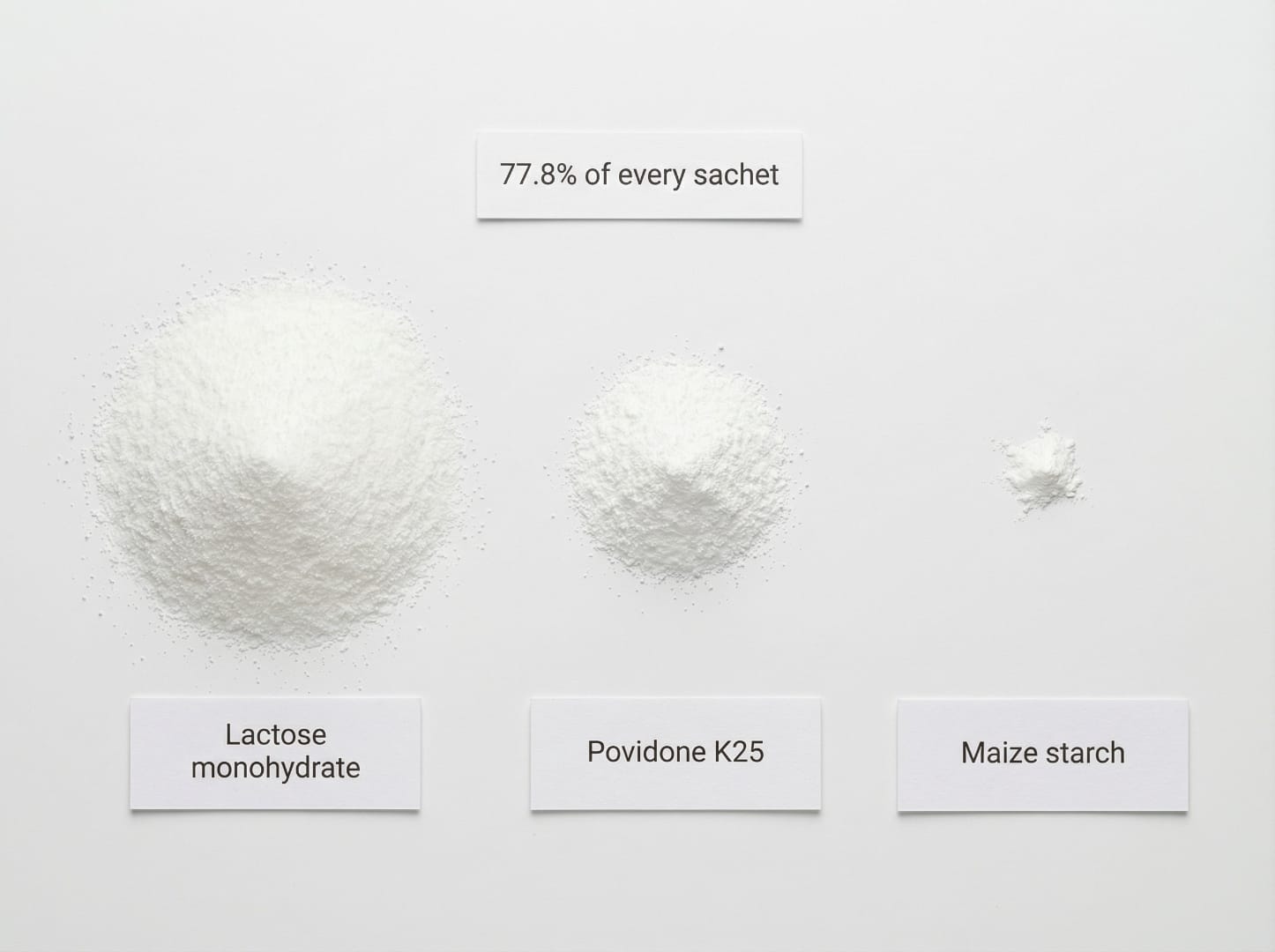
Visual representation of the three excipients by relative proportion in each Panacur C sachet
If you're using Panacur C as a source of fenbendazole, you know what the label tells you: 222mg of fenbendazole per 1-gram sachet. What the label doesn't tell you is what makes up the other 778 milligrams.
That 77.8% of each dose — the part the label doesn't mention — consists of three pharmaceutical excipients: lactose monohydrate, povidone K25, and maize starch. Each of these has a documented history of causing allergic reactions in humans, including in some cases anaphylaxis. None of them appears on the Panacur C packaging sold in the United States.
This article isn't an argument against fenbendazole. It's an argument for knowing what you're actually consuming when you open one of those packets.
Why the Label Says Nothing
Panacur C is a veterinary product. In the United States, veterinary oral medications are regulated under a different framework than human pharmaceuticals. FDA 21 CFR 201.105 — the regulation governing labeling requirements for veterinary drugs — does not require manufacturers to list inactive ingredients on over-the-counter veterinary products.
This is a significant regulatory asymmetry. If you purchase a human over-the-counter tablet, every inactive ingredient must appear on the label under the "Other Ingredients" section, per FDA requirements. The same obligation does not exist for veterinary products, even when those products are being used off-label by humans.
The result is a gap: millions of people using Panacur C as part of off-label fenbendazole protocols have no way of knowing — from the product itself — what they are actually consuming beyond the active ingredient.
How We Know What's in It
The full composition of Panacur C (fenbendazole 22.2% w/w granules) is documented in the UK Veterinary Medicines Directorate (VMD) Summary of Product Characteristics (SPC) — the regulatory dossier required for veterinary product authorization in the United Kingdom.
According to the UK VMD SPC, the qualitative and quantitative composition per 1g sachet is:
- Fenbendazole (active) — 222mg
- Lactose monohydrate — excipient (quantity not individually specified; combined excipients = 778mg)
- Povidone 2500 (PVP K25) — excipient
- Maize starch — excipient
Source: UK VMD Product Database — Panacur Granules 22.2% (Vm 01708/4019)
The SPC exists because UK regulators require manufacturers to disclose the complete composition of veterinary medicinal products. The same product — manufactured by Merck Animal Health — is sold in the US without this disclosure being available on the label or packaging insert.
The Composition at a Glance
Excipients comprise: lactose monohydrate, povidone 2500 (PVP K25), and maize starch — proportions not individually disclosed in the SPC.
To frame this differently: for every gram of Panacur C you consume, less than one quarter is the compound you're seeking. The majority — by weight — is a mixture of a dairy-derived sugar, a synthetic polymer binder, and a plant-derived starch.
What You Actually Consume: The Math
These are not trivial quantities. For individuals with sensitivities to any of the three excipient components — or who are managing conditions where each matters (dairy intolerance, known PVP sensitivity, corn allergy) — the cumulative load across a multi-month protocol represents meaningful and previously invisible exposure.
The Three Excipients: What They Are and Why They Matter
Each excipient in Panacur C has a distinct pharmaceutical function — and a distinct allergenic profile. The table below summarizes the key facts for each.
| Excipient | Function | Allergenic Risk | Key Cases / Evidence |
|---|---|---|---|
| Lactose monohydrate | Filler / diluent — provides bulk and flow properties to granule formulation | High (milk-allergic) | EMA CHMP guideline (2016) identifies anaphylaxis risk in milk-protein-allergic patients from lactose in inhalation products; trace milk proteins co-purify with pharmaceutical lactose |
| Povidone 2500 (PVP K25) | Binder — holds granule particles together; improves compressibility | Documented anaphylaxis | Anaphylaxis reported from IV paracetamol formulations containing PVP; anaphylaxis from povidone-iodine surgical products (povidone component specifically implicated); delayed hypersensitivity documented |
| Maize starch | Disintegrant — promotes granule breakdown and drug release in GI tract | Moderate (hidden allergen) | Documented anaphylaxis to maize starch in pharmaceutical products; present in approximately 37% of medications as excipient; frequently unrecognized as allergen source in drug reactions |
Lactose Monohydrate: The Dairy Ingredient Nobody Warns About
Lactose is widely used as a pharmaceutical excipient and is generally considered safe for the vast majority of users. However, pharmaceutical-grade lactose is derived from cow's milk, and the purification process does not eliminate all milk proteins. Residual proteins — including caseins and whey proteins — can remain at trace levels.
For people with cow's milk protein allergy (distinct from lactose intolerance), these trace proteins can trigger immune-mediated reactions. In 2016, the European Medicines Agency's Committee for Medicinal Products for Human Use issued a guideline specifically addressing this risk: EMA/CHMP/186428/2016 — "Lactose and starch used as excipients: Questions and answers." The guideline acknowledges the anaphylaxis risk and recommends labeling warnings for products using lactose in inhalation routes, where the risk is highest. Oral administration carries lower but non-zero risk for sensitive individuals.
"Patients with rare hereditary problems of galactose intolerance, total lactase deficiency or glucose-galactose malabsorption should not take this medicine." — Standard EMA-mandated warning text for lactose-containing products, absent from Panacur C label
Povidone (PVP K25): A Well-Documented but Underappreciated Allergen
Povidone (polyvinylpyrrolidone, PVP) is a synthetic water-soluble polymer used extensively as a binder in pharmaceutical tablets and granules. It is also the carrier molecule in povidone-iodine antiseptic solutions — and it is the povidone component, not the iodine, that has been identified as the allergen in a significant subset of reported reactions.
Case reports of anaphylaxis to povidone span multiple decades and multiple routes of administration. Reactions have been documented from:
- Intravenous paracetamol (acetaminophen) formulations containing PVP as a solubilizing excipient — with anaphylaxis attributed specifically to the PVP component after iodine allergy was ruled out
- Povidone-iodine wound irrigation and surgical prep solutions
- Oral tablets in which PVP was the identified sensitizing agent upon allergy workup
- Subcutaneous depot injections using PVP-based vehicles
The mechanism is IgE-mediated hypersensitivity in documented cases. Cross-reactivity between different PVP molecular weight grades (K17, K25, K30, K90) has been reported, meaning sensitization from one source can produce reactions to PVP in other products. A 2024 systematic review published in Internal Medicine Journal identified povidone as among the excipients with the strongest evidence base for true allergic reactions.
Maize Starch: The Hidden Allergen in 37% of Medications
Maize (corn) starch serves as a disintegrant in granule and tablet formulations — it absorbs water and swells, breaking apart the dosage form and promoting drug release. It is ubiquitous in pharmaceuticals.
Corn allergy, while less common than peanut or tree nut allergy, is a recognized clinical entity. What makes it particularly problematic is that it frequently goes unrecognized as the source of drug reactions, because most people — and many clinicians — do not think to check whether a medication contains corn-derived excipients. The allergen is rarely listed on labels (particularly veterinary labels).
Anaphylaxis to pharmaceutical maize starch has been documented in multiple case reports. The protein content of pharmaceutical-grade maize starch is typically very low but not zero, and residual zein (corn storage protein) can persist through processing. A 2024 systematic review found maize starch among the excipients most frequently implicated in published excipient-related adverse reactions across a dataset of 39 case report series encompassing 61 patients.
The 2024 Systematic Review: Excipients as Allergens
In 2024, a systematic review published in Internal Medicine Journal compiled and analyzed all available published case reports of allergic reactions attributable to pharmaceutical excipients rather than active ingredients. The findings provide important context for the Panacur C excipient question.
- 39 case report series identified meeting inclusion criteria
- 61 patients with confirmed or probable excipient-mediated reactions
- Reaction severity ranged from urticaria (hives) to anaphylaxis
- Excipients implicated included: povidone, carboxymethylcellulose, polysorbates, macrogol (PEG), lactose, and starch derivatives
- Diagnosis was frequently delayed due to failure to consider excipients as the causative agent
- Oral routes of administration were represented alongside IV and topical routes
- Clinical conclusion: Excipient allergy is underdiagnosed, under-reported, and underappreciated as a source of drug hypersensitivity reactions
The review highlights a systemic problem: when a patient reacts to a medication, the default assumption is that the reaction is to the active pharmaceutical ingredient. Excipients are rarely tested. The result is misattribution — and continued exposure if the patient switches to a different product containing the same excipient.
Why This Matters for Off-Label Fenbendazole Users
The typical off-label fenbendazole user is taking Panacur C for a personal health protocol — often during or after cancer treatment, or as a preventive measure based on preclinical and case report data. Many of these users are:
- Already immunocompromised or undergoing treatment that affects immune function
- Managing multiple supplements and medications simultaneously, increasing the likelihood of excipient overlap
- Older adults, in whom allergy threshold can shift or new sensitivities develop
- Following protocols over months or years, creating cumulative excipient exposure
- Self-managing without a prescribing physician reviewing the full excipient load
In this population, an unknown allergenic excipient load is not a trivial concern. A reaction that gets attributed to "the fenbendazole" — when it is actually mediated by lactose protein, PVP, or maize starch — leads to abandonment of a protocol that might have been continued safely with a different formulation.
Conversely, someone with a known dairy allergy, corn allergy, or documented PVP sensitivity has no way to know — from the Panacur C label — that they are consuming these substances at all.
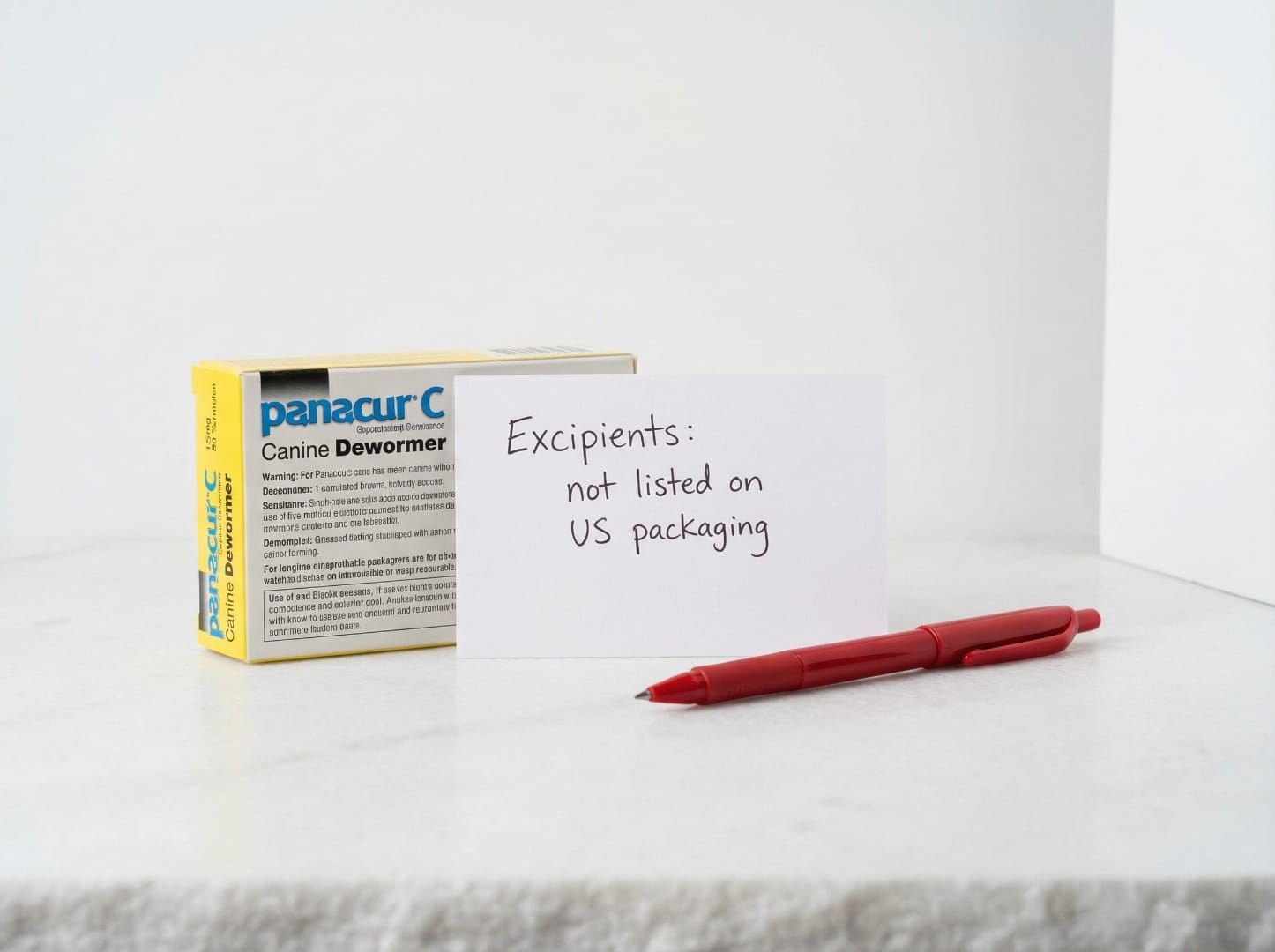
Panacur C US packaging lists only fenbendazole — excipients are not disclosed to consumers
The Regulatory Gap
The excipient transparency gap for Panacur C is not an accident or an oversight by Merck Animal Health. It is a structural consequence of how veterinary OTC products are regulated in the United States.
- FDA 21 CFR 201.105 — Veterinary OTC drug labeling requirements do not include mandatory disclosure of inactive ingredients. The regulation specifies what must appear on veterinary labels; excipients are not on the list.
- UK VMD SPC requirement — The UK requires full qualitative composition disclosure in the Summary of Product Characteristics for all authorized veterinary medicinal products. This is why the excipient data exists — but only in the UK regulatory dossier, not on the US product label.
- Off-label human use is not addressed — There is no regulatory mechanism in the US that requires veterinary product manufacturers to update labeling or provide excipient information when evidence emerges that their product is being used off-label by humans at scale.
- No adverse event reporting requirement — Consumers using Panacur C off-label who experience adverse reactions have no formal reporting pathway that would aggregate these events or trigger label review.
- EMA guidance exists — but doesn't apply — EMA/CHMP guidelines on excipient labeling (including the 2016 lactose guideline and the 2019 Guideline on Excipients in the Labelling and Package Leaflet of Medicinal Products) apply to human medicinal products in Europe. They do not apply to veterinary products or to US products.
The practical result: a human using Panacur C off-label is consuming a product formulated, labeled, and regulated for dogs — with no access to excipient information from the label itself, and no regulatory requirement for the manufacturer to provide it.
What Can You Do With This Information?
This article does not argue that Panacur C is unsafe, or that fenbendazole is problematic. The evidence base for fenbendazole's mechanism of action and the case report literature on its off-label use is separate from — and unaffected by — the excipient question.
What the excipient data allows you to do is make more informed decisions:
Dairy / milk protein allergy: Panacur C contains lactose monohydrate, which is derived from cow's milk and may contain trace milk proteins. This is not disclosed on the US label. Individuals with cow's milk protein allergy (not just lactose intolerance) should be aware of this exposure.
Corn / maize allergy: Panacur C contains maize starch. Trace corn proteins may be present. This is not disclosed on the US label.
Known PVP sensitivity or povidone-iodine allergy: Panacur C contains povidone 2500. If you have experienced reactions to povidone-iodine products or have been identified as PVP-sensitive on allergy testing, be aware of this exposure.
Human-formulated fenbendazole products manufactured in pharmaceutical facilities — such as products made by compounding pharmacies for human use, or regulated human fenbendazole formulations available in some countries — must, in most jurisdictions, disclose their full excipient composition. These may provide greater transparency for individuals concerned about specific excipients. Product quality, purity, and excipient profiles vary substantially by source and manufacturer.
Allergic reactions attributed to fenbendazole should prompt consideration of excipient-mediated allergy before assuming the active ingredient is the cause. Referral to an allergist for specific excipient testing (including povidone and corn starch) may clarify the source of the reaction. Stopping a protocol due to a misattributed excipient reaction — without testing — may mean abandoning a potentially tolerated active compound unnecessarily.
Conclusion
Every gram of Panacur C contains 778mg of undisclosed excipients. Over a standard 3-day fenbendazole cycle, you consume more than 2 grams of these compounds — lactose monohydrate, povidone K25, and maize starch — without any notification from the product label that they exist.
All three have documented histories of causing allergic reactions in humans. Two have documented anaphylaxis cases from oral or systemic routes of administration. The regulatory framework that permits this disclosure gap was designed for dogs, not for the growing number of humans using the product off-label.
The question this article raises is not whether fenbendazole works, or whether Panacur C is appropriate to use. It is a simpler question: shouldn't you know what you're consuming?
The answer, evidently, depends on whether you know to look for the UK VMD SPC.
Disclaimer — This article is for informational and educational purposes only. It does not constitute medical advice, and it does not endorse or recommend the off-label use of any veterinary product by humans. Any decisions regarding health protocols, medications, or allergen management should be made in consultation with a qualified healthcare professional. The authors have no financial relationship with any manufacturer of fenbendazole products.


